Prevention
Catch flaky and broken tests on pull requests before they reach your codebase.
Prevention monitors tests introduced or modified in pull requests. By rerunning tests on PRs, it detects flaky behavior before code merges, keeping your codebase reliable.
How it works
Section titled How it worksWhen a pull request runs tests, Mergify reruns them to check for consistency. Tests that produce different results on the same commit are flagged as flaky. This happens transparently as part of your existing CI pipeline, with no changes to your test code needed.
Tests caught as flaky on a PR are prevented from silently degrading your test suite. You can review their health status before deciding to merge.
What you can track
Section titled What you can trackPrevention provides key metrics to help you understand test reliability on pull requests:
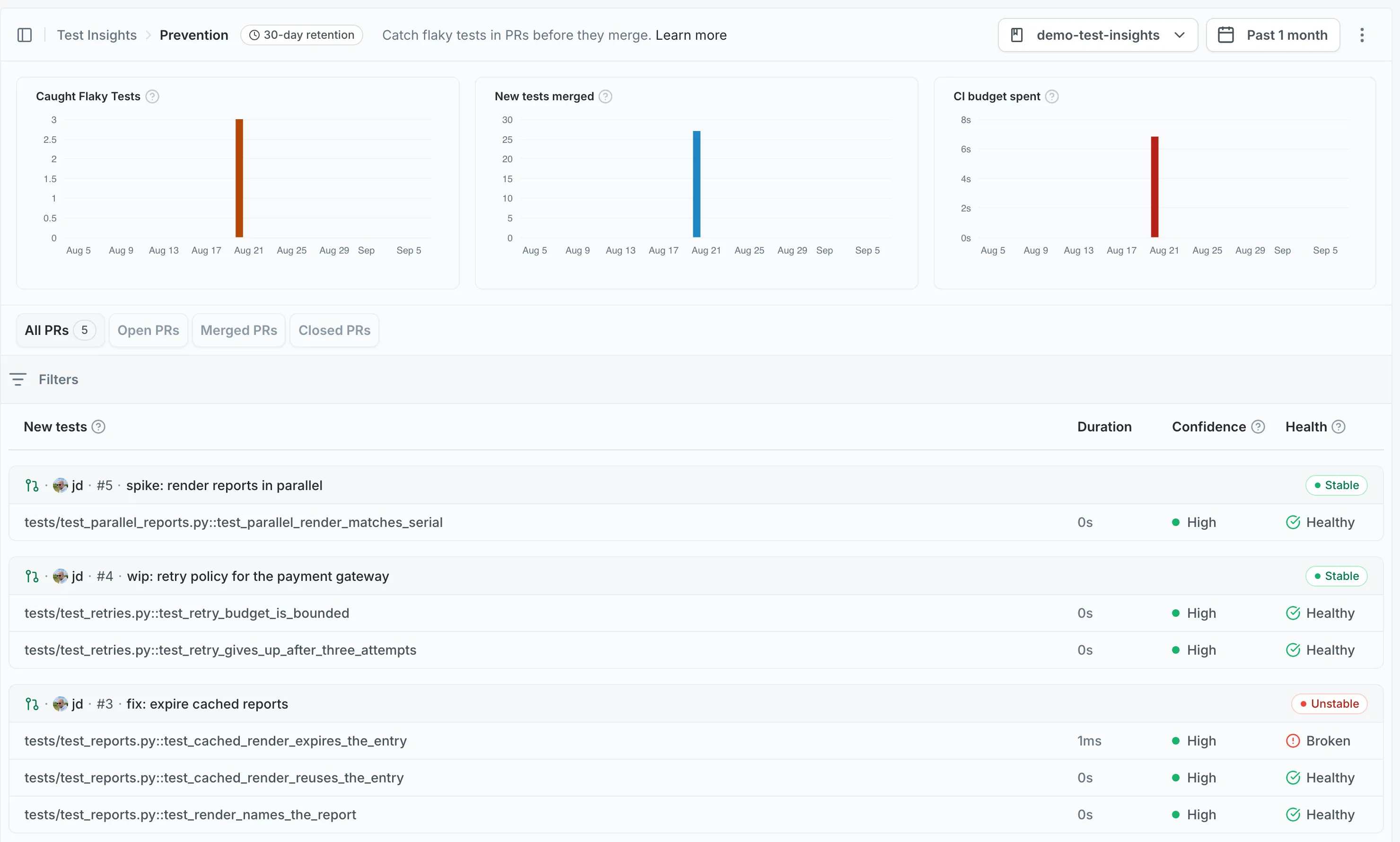
Caught flaky tests
Section titled Caught flaky testsThe number of flaky tests detected during PR reruns. This is the core value of Prevention: every caught test is a reliability problem that didn’t make it into your codebase.
New tests
Section titled New testsTests being introduced on PRs, along with their health status. Each new test is classified as healthy, flaky, or broken based on its rerun results. This helps you spot unreliable tests before they’re merged.
CI budget spent
Section titled CI budget spentThe total CI time spent on reruns. This metric helps teams understand the cost of flaky test prevention and make informed trade-offs between thoroughness and CI budget.
Practical workflows
Section titled Practical workflowsReviewing tests before merging
Section titled Reviewing tests before mergingWhen a PR introduces or modifies tests, check the Prevention page to see their health status. Tests with a flaky or broken status should be investigated before merging.
Filtering by pull request state
Section titled Filtering by pull request stateUse the pull request state filter to focus on specific PRs:
- Open: Tests on PRs still in review
- Merged: Tests on PRs that have already been merged
- Closed: Tests on PRs that were closed without merging
Understanding confidence on new tests
Section titled Understanding confidence on new testsNew tests have limited run data, so their confidence level may be low. A low confidence means the health status could change as more data is collected. Consider waiting for more runs before drawing conclusions about a test’s reliability.
Setup
Section titled SetupPrevention requires a test framework plugin that instruments test runs, and it is opt-in per repository. Once a plugin is installed, set a rerun budget on the Prevention page in the dashboard to enable it. Until then, Mergify collects test results but does not rerun tests.
See the test framework configuration for setup instructions specific to your framework (pytest-mergify, rspec-mergify, etc.).
Was this page helpful?
Thanks for your feedback!