Mergify Queue Command
Add a pull request to a merge queue.
The queue command in Mergify offers users a direct way to interact with the
Mergify merge queue, right from their pull request
comments. With this command, users can add a pull request to a merge
queue or re-add it after it has been dequeued.
To enter a queue, a pull request must match the queue_conditions of a queue
rule. See Adding a pull request to the merge
queue for
more details.
Syntax
Section titled Syntax@mergifyio queueThe command takes no arguments: the pull request waits until it matches the
queue_conditions of a queue rule, then enters the queue under the first rule
it matches.
Re-queuing a previously dequeued pull request
Section titled Re-queuing a previously dequeued pull requestIf a pull request was removed from the merge queue (due to a failed check, a
flaky test, or a manual dequeue), you can re-add it using the same queue
command:
@mergifyio queueThe command resets the pull request status and places it back in the merge queue, allowing Mergify to retry validation.
Running the command twice
Section titled Running the command twiceA queue command stays pending until the pull request matches a queue rule’s
queue_conditions, so a second one can arrive while the first is still waiting.
A second @mergifyio queue is then ignored, and Mergify answers that it is
already running from a previous command.
To call off a pending queue command, use the dequeue
command.
Pushing while the command waits
Section titled Pushing while the command waitsIf someone pushes to the pull request while a queue command is still waiting
for queue_conditions to match, Mergify cancels the command and replies that
new commits were pushed, naming who pushed them. The command vouches for the
commits its author could see, so review the new ones and run @mergifyio queue
again.
Mergify’s own pushes don’t count, so an update or a
rebase that brings the pull request up to date leaves the
pending command alone. Once the pull request has entered the queue, a push
takes it out of the queue instead of cancelling a pending command.
Queueing with a checkbox
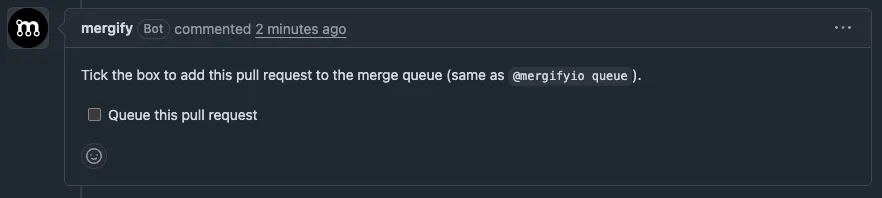
Section titled Queueing with a checkboxIf you’d rather not type a command, Mergify can post a checkbox you can tick to queue your pull request:
-
Queue this pull request comes in a comment of its own. Mergify posts it on every open pull request one of your queue rules covers, unless the pull request is a draft, is already queued, has a merge queue status comment, or is queued automatically by your configuration. Tick it to add the pull request to the merge queue: if it doesn’t match its
queue_conditionsyet, it waits and enters the queue once they pass. If someone pushes new commits while it waits, the request is cancelled. Ifstatus_commentsisall, the default, the checkbox then comes back in the status comment, so you can tick it again. -
Requeue this pull request comes in the merge queue status comment, after the pull request has left the queue without being merged. Tick it to put the pull request back in the queue.
Ticking a checkbox does exactly what the @mergifyio queue command does. The
action is attributed to the person who ticked it, and the same
command restrictions and write-permission checks
apply, so a checkbox can’t queue a pull request that the person couldn’t queue
manually.
This is enabled by default. To turn it off, set queue_controls_comment to
false in your merge_queue configuration:
merge_queue: queue_controls_comment: falseQueueing through the API
Section titled Queueing through the APIA script or a bot can queue a pull request without posting a comment, by calling the Mergify API:
curl -X POST \ -H "Authorization: Bearer <token>" \ https://api.mergify.com/v1/repos/<owner>/<repository>/merge-queue/pull/<number>/queueThe request has no body and names no queue. It does what @mergifyio queue
does: the pull request waits until it matches the queue_conditions of a queue
rule, then enters the queue under the first rule it matches. A push while it
waits cancels the request, as described in Pushing while the command
waits.
Mergify answers 202 Accepted once it has recorded the request, which can be
long before the pull request enters the queue. To follow what happens next, read
the pull request’s queue status or its events.
The call needs an application key
granted Merge Queue at Read & write, or a Mergify user
token whose owner can write to the
repository. The command restrictions set for queue
apply to it as they apply to a comment. A user token is judged as the person it
belongs to. An application key belongs to no one, so it is judged with admin
permission and no sender: it passes sender-permission >= write, and fails a
condition requiring a given sender, such as sender = @team.
When Mergify refuses the request, the response body carries an error_code
next to the detail message:
| Status | error_code |
Meaning |
|---|---|---|
403 |
COMMAND_RESTRICTED |
Your commands_restrictions don’t let the caller queue this pull request. |
404 |
PULL_REQUEST_NOT_FOUND |
The repository has no pull request with this number. |
409 |
PULL_REQUEST_NOT_QUEUEABLE |
The pull request is closed, merged or locked, or the merge queue opened it. |
409 |
PULL_REQUEST_ALREADY_QUEUED |
The pull request is already in the merge queue. |
409 |
MERGE_QUEUE_DISABLED |
The merge queue is not enabled on the repository. |
422 |
CONFIGURATION_INVALID |
The repository’s Mergify configuration is invalid. |
Queueing a pull request that is already in the queue, for example, answers:
{ "detail": "Pull request `123` is already queued", "error_code": "PULL_REQUEST_ALREADY_QUEUED"}To take the pull request out again, or to call off a request that is still waiting, use the dequeue endpoint. The API Reference lists both endpoints with their responses.
In the event log
Section titled In the event logA request made through the API shows up in the pull request’s events like a
command posted in a comment: as a command.queue event, or command.dequeue
for a dequeue. You can read it in the dashboard, with
mergify events, or through the Activity Log
API. These fields tell who asked and how:
-
command_triggerisapifor a request made through the API, anddashboardfor one made from the Mergify dashboard. -
requested_bynames who asked: the user behind the token, or the application key.requested_by_staffistruewhen Mergify staff made the request while helping you. -
authoris null when an application key or Mergify staff made the request; readrequested_byinstead. -
comment_idis null, since no comment carried the command.
Was this page helpful?
Thanks for your feedback!